Alkaline Diet and Candida: Does Eating Alkaline Foods Actually Help?
You’ve probably found completely contradictory advice about Candida and alkaline diets. Some websites say you should alkalise your body to fight Candida. Others say Candida actually prefers alkaline conditions. So which is right?
The short answer: an alkaline diet cannot simply turn your body alkaline, and there isn’t good clinical evidence that eating alkaline foods can cure a Candida infection.
Different parts of your body naturally maintain very different pH levels. Candida is also remarkably adaptable and can survive in a range of environments.
That doesn’t mean the foods you eat are irrelevant to health. It means the relationship between diet, pH and Candida is considerably more complicated than the popular idea that “alkaline kills Candida.”
Why is there so much contradictory advice about Candida and pH?
Search online for an alkaline Candida diet and you’ll quickly encounter two apparently incompatible ideas.
One says that modern diets make the body too acidic and that eating alkaline foods helps create an environment in which Candida cannot thrive. Another says that Candida can grow well in neutral or alkaline conditions, so making the body more alkaline could actually encourage it.
Both explanations make something very complicated sound wonderfully simple.
The problem is that your body doesn’t have one single pH — and Candida isn’t controlled by one simple pH switch either.
First: what does “alkaline” actually mean?
The pH scale describes how acidic or alkaline something is. A pH below 7 is acidic, 7 is neutral, and a pH above 7 is alkaline.
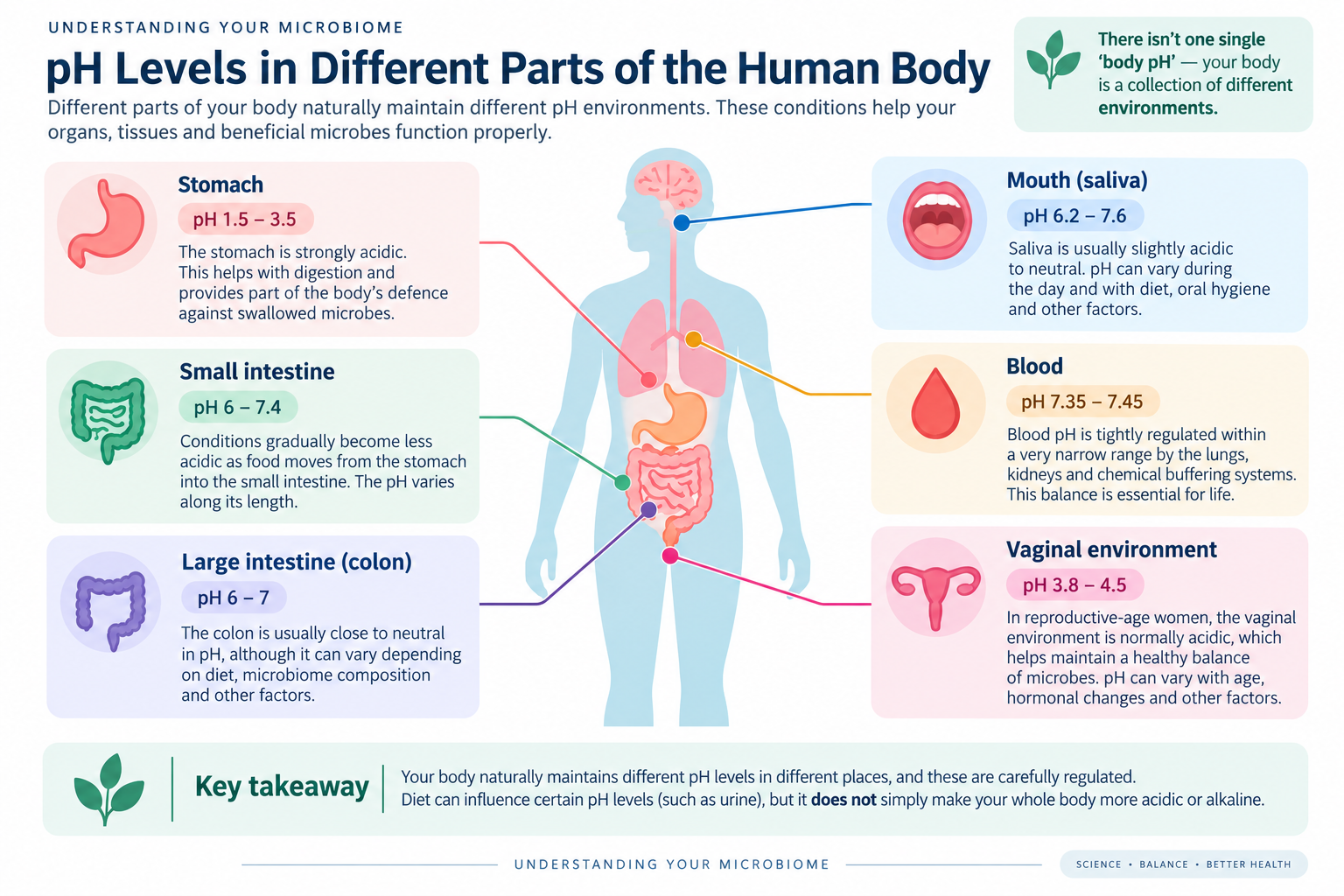
But talking about the body’s pH can be misleading because different areas of the human body are supposed to have very different conditions.
Can an alkaline diet actually change your body’s pH?
This is where one of the biggest misunderstandings about alkaline diets begins.
What you eat can affect the acid load your kidneys have to deal with, and diet can influence the pH of your urine. That is very different from saying that food can freely change the pH of your blood or make your entire body alkaline.
Your body tightly controls blood acid-base balance because even relatively small disturbances can be medically important. Your lungs, kidneys and chemical buffering systems are constantly involved in maintaining that balance.
So does Candida prefer acid or alkaline conditions?
This is where things get particularly interesting.
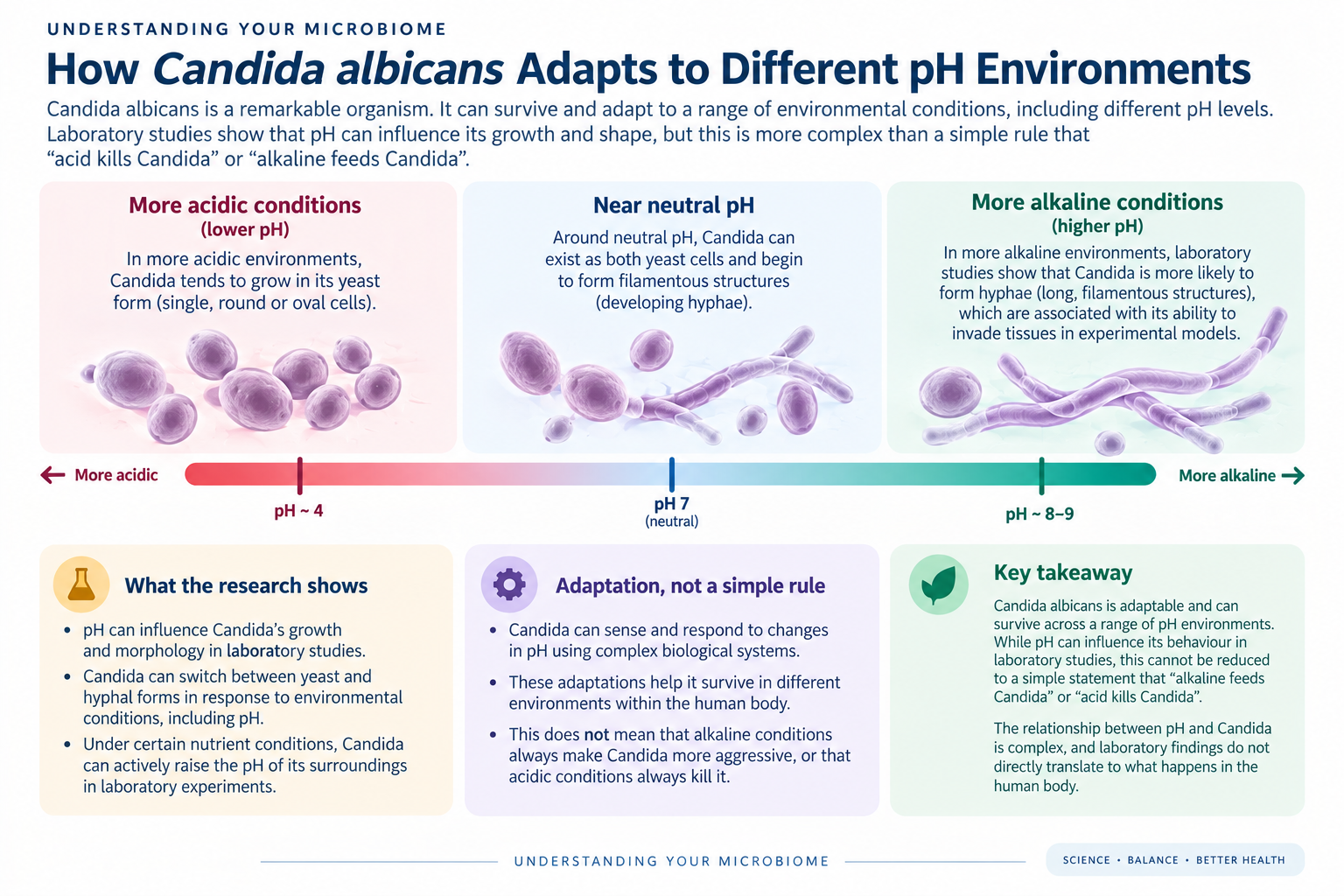
Candida albicans encounters very different environments in the human body and has biological systems that allow it to respond to changing conditions, including changes in pH.
Laboratory studies show that environmental pH can influence Candida’s behaviour and morphology — including its ability to shift between different growth forms.
But that does not translate into a simple rule that “acid kills Candida” or “alkaline feeds Candida.”
Candida can even change its own surroundings
One fascinating laboratory finding makes the simple alkaline-versus-acid story even less convincing.
Researchers have shown that under particular nutrient conditions, Candida albicans can actively alter the pH of its immediate environment. In laboratory experiments, Candida growing under certain nutrient-limited conditions raised the surrounding pH, and this was associated with a transition toward hyphal growth.
That tells us something important about Candida biology: this organism doesn’t merely sit passively in whatever pH environment it happens to encounter. It can sense and respond to its surroundings.
Does that mean an alkaline diet could make Candida worse?
There isn’t good evidence to support that conclusion either.
It would be tempting to look at laboratory studies showing that pH can influence Candida morphology and conclude that alkaline foods must make Candida more aggressive.
But that’s another leap the evidence doesn’t justify.
A laboratory culture medium is not the same thing as the human body. Eating vegetables that are classified as “alkaline-forming” does not reproduce those experimental conditions inside your tissues.
So replacing the claim “alkaline diets kill Candida” with “alkaline diets make Candida worse” simply swaps one oversimplification for another.
Does an alkaline diet kill Candida?
There is no good clinical evidence that an alkaline diet eradicates Candida infection by changing the body’s pH.
Recognised Candida infections — candidiasis — are treated according to where the infection occurs, its severity, the Candida species involved when relevant, and the person’s health circumstances. Antifungal medicines are the established treatment.
What about an “alkaline Candida diet”?
This is where we need to separate the theory behind a diet from the foods the diet happens to encourage.
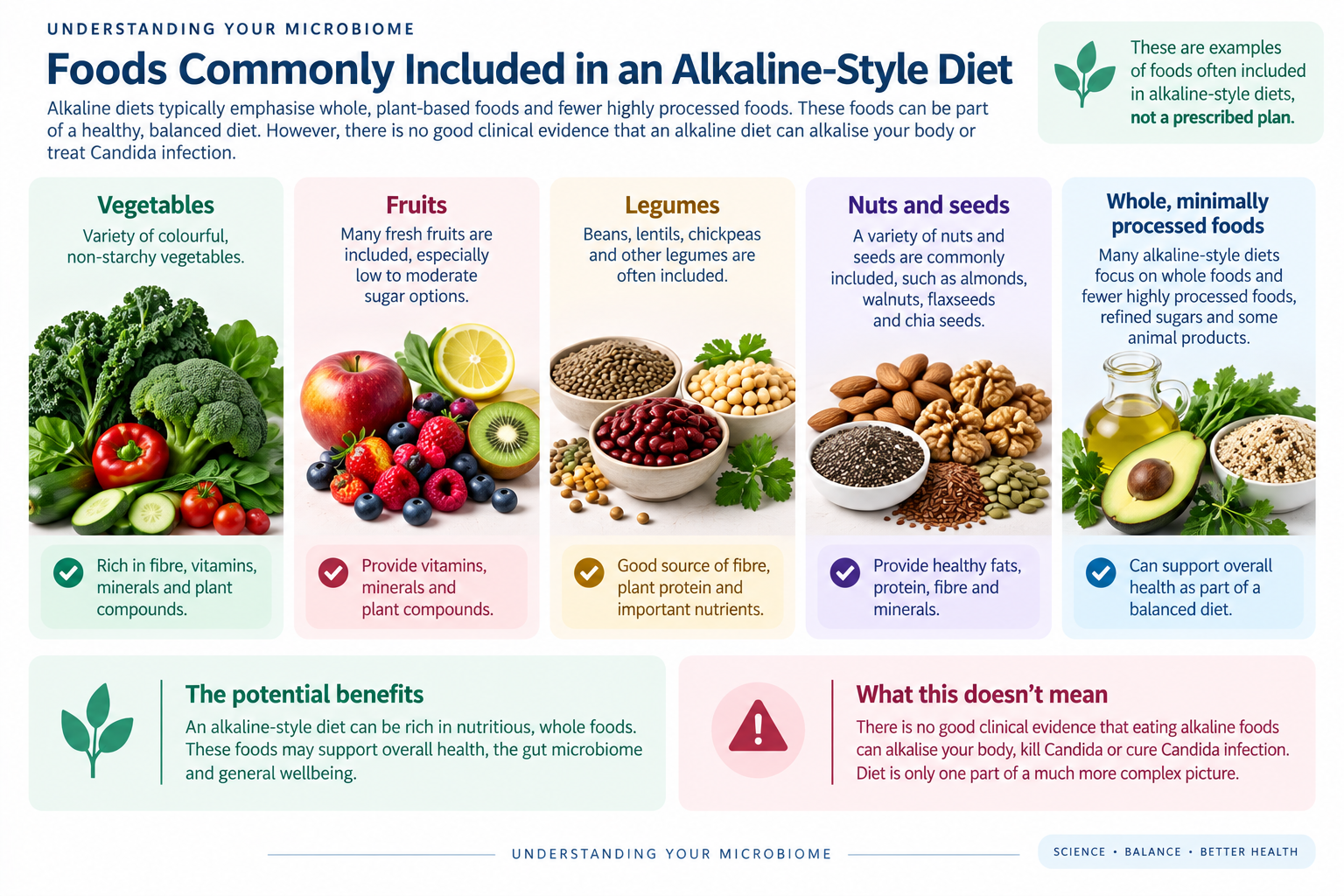
Many versions of an alkaline diet emphasise vegetables, fruit, legumes, nuts, seeds and less heavily processed food. Some also reduce refined carbohydrates, sugary foods, processed meat or other foods depending on the particular version being followed.
A person may therefore improve the overall quality of their diet while following an alkaline eating plan.
That doesn’t prove that the benefit came from “alkalising” the body or killing Candida.
Could eating differently still affect Candida?
Potentially — but this is a much broader and more interesting question than whether food makes the body “acidic” or “alkaline.”
Diet interacts with the gut microbiome, metabolism and many aspects of human physiology. Researchers are also studying relationships between diet, bacteria and fungi within the intestinal microbiome.
Those relationships are complex, however, and evidence that a dietary pattern is associated with Candida colonisation is not the same as evidence that a particular diet treats Candida infection.
This distinction matters.
Candida in your gut isn’t automatically an infection
Candida can normally live in the gastrointestinal tract without causing disease.
In a 2023 study involving 695 healthy volunteers, Candida albicans intestinal carriage was detected in 82.9% of participants using quantitative PCR testing.
Finding Candida therefore does not automatically mean someone has candidiasis. Colonisation and infection are not the same thing.
Why might someone feel better after starting an alkaline diet?
This is an important question because someone’s improvement can be completely genuine even if the explanation they were given for that improvement is wrong.
Imagine someone previously ate relatively few vegetables and a lot of highly processed foods, sugary snacks and refined carbohydrates. They then begin an “alkaline Candida diet” that encourages more whole foods, vegetables, legumes, nuts and seeds.
They may well feel different.
But that doesn’t demonstrate that their blood became alkaline or that Candida was killed. Several things changed simultaneously, making it impossible to identify Candida or pH as the explanation simply from feeling better.
What should you do if you think you actually have candidiasis?
Candida normally lives on and inside the human body, so the presence of Candida alone does not establish that it is causing illness.
Candidiasis refers to an actual infection caused by Candida. It can occur in different places — including the vagina, mouth and throat — and the appropriate diagnosis and treatment depend on the type of infection.
If symptoms are persistent, recurrent, unusual or aren’t responding as expected to treatment, getting an appropriate medical assessment is more useful than repeatedly trying to manipulate your body’s pH through diet.
This is particularly important because symptoms people attribute to Candida can have other causes.
The bottom line
The relationship between Candida and pH is real — but it is far more complicated than the claim that eating alkaline foods can “alkalise your body” and kill Candida.
Different parts of the body naturally maintain different pH environments, while Candida albicans has sophisticated mechanisms for adapting to changing conditions.
An alkaline-style diet may contain plenty of nutritious foods, but there is no good clinical evidence that it cures candidiasis by changing your body’s pH.
So if you enjoy vegetables, fruit, legumes, nuts and other whole foods, there are plenty of reasons to include them as part of a varied diet. You just don’t need to imagine that you’re turning your body alkaline in the process.
Frequently asked questions
Does Candida like an alkaline environment?
Candida can adapt to a range of environmental conditions. Laboratory research shows that pH can influence its behaviour and morphology, but this cannot be reduced to a simple rule that Candida only thrives in either acidic or alkaline conditions.
Can an alkaline diet kill Candida?
There is no good clinical evidence that an alkaline diet cures candidiasis by changing body pH. Recognised Candida infections are treated according to their type and severity, generally using antifungal medicines.
Can food change your body’s pH?
Diet can influence urinary pH and the acid load handled by the kidneys, but blood pH is tightly regulated by the body. Changes in urine pH should not be interpreted as evidence that the entire body has become more acidic or alkaline.
Is finding Candida in the gut evidence of Candida overgrowth?
Not by itself. Candida can be part of the normal human gut mycobiota. Detecting Candida and diagnosing a Candida infection are different things and need to be interpreted in the appropriate clinical context.
Scientific references
- Centers for Disease Control and Prevention (CDC). Candidiasis Basics . Updated April 24, 2024.
- Centers for Disease Control and Prevention (CDC). Treatment of Candidiasis . Updated April 24, 2024.
- Schwalfenberg GK. The Alkaline Diet: Is There Evidence That an Alkaline pH Diet Benefits Health? Journal of Environmental and Public Health. 2012. PMID: 22013455.
- Vylkova S, Carman AJ, Danhof HA, Collette JR, Zhou H, Lorenz MC. The Fungal Pathogen Candida albicans Autoinduces Hyphal Morphogenesis by Raising Extracellular pH . mBio. 2011;2(3):e00055-11. PMID: 21586647.
- Delavy M, Sertour N, Patin E, et al. Unveiling Candida albicans Intestinal Carriage in Healthy Volunteers: the Role of Micro- and Mycobiota, Diet, Host Genetics and Immune Response . Gut Microbes. 2023;15(2):2287618. PMID: 38017705.
Medical information: This article is for general educational purposes and is not a substitute for individual medical diagnosis or treatment. If you have persistent or recurrent symptoms, seek advice from an appropriate healthcare professional.