Attogram Candida Purge Program: An Evidence-Based Guide
The Attogram Candida Purge Program is promoted as a way to address Candida overgrowth using a combination of dietary changes and supplements. Its ingredients are described as working together to target Candida in the digestive tract while helping to cleanse the intestines.
But does the program have reliable scientific evidence behind it?
Some of its ingredients have been investigated for their biological properties. Caprylic acid, for example, has demonstrated antifungal activity in laboratory studies. Psyllium is an established source of dietary fiber, while probiotics such as acidophilus have been studied in several health contexts.
However, evidence about individual ingredients is not the same as evidence that a complete program works. This guide examines what is known about the Attogram Candida Purge Program, what remains unproven, and the safety considerations readers should understand.
The short answer: The available evidence does not establish that the complete Attogram Candida Purge Program treats Candida-related illness in humans.
Its proposed intestinal cleansing mechanism remains unverified, and the program’s precise formulation and safety cannot be fully assessed without the original protocol and product details.
What Is the Attogram Candida Purge Program?
Publicly available promotional information describes the Attogram Candida Purge Program as combining a modified diet with several ingredients:
- Caproyl®, described as liquid caprylic acid
- Bentonite
- Psyllium
- Acidophilus
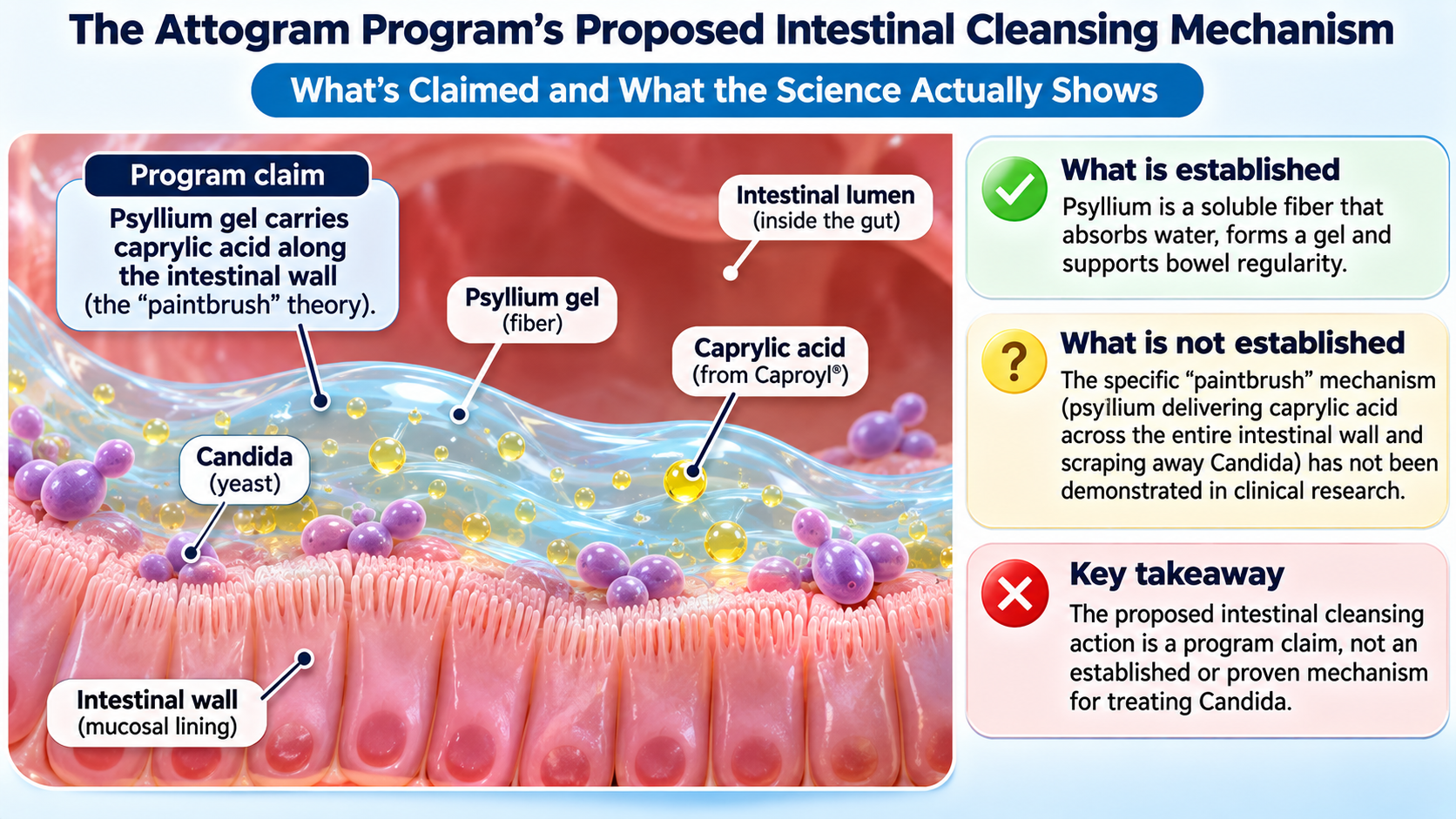
The promotional description suggests that these ingredients work together to target Candida and support intestinal cleansing. It also describes psyllium gel as helping distribute caprylic acid along the intestinal wall.
These descriptions should be understood as claims made in promotional material. The original program booklet, full product labels, ingredient quantities, and complete instructions were not available for independent verification. Consequently, the precise formulation and recommended duration of the program cannot be confirmed.
What Does the Science Say About the Ingredients?
Caprylic acid
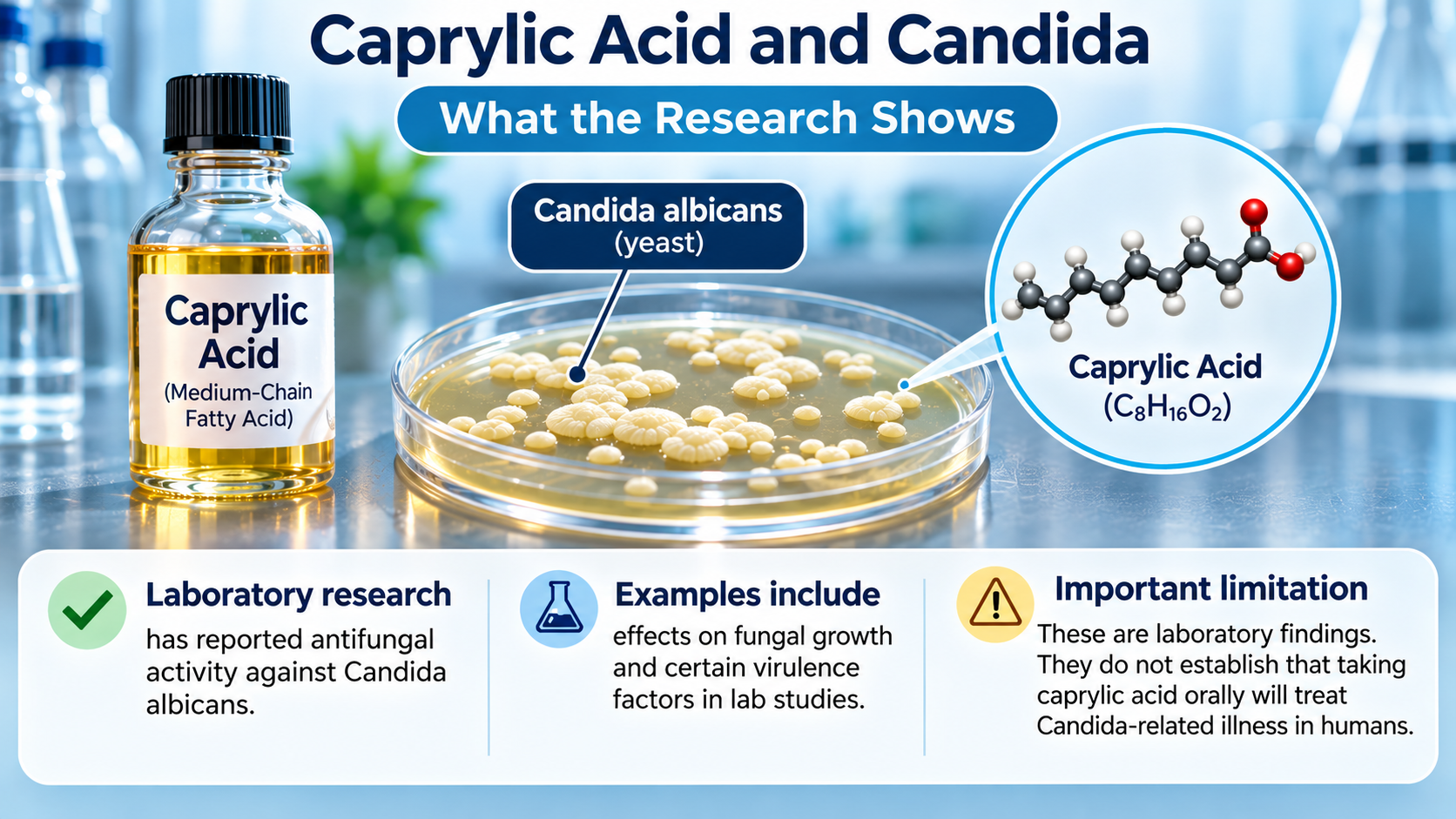
Caprylic acid is a medium-chain fatty acid. Laboratory research has investigated its effects on Candida albicans, including fungal growth and certain characteristics associated with its ability to cause disease.
Some studies have reported antifungal effects under laboratory conditions. Other research has examined related fatty acids in animal models of oral candidiasis.
These findings are scientifically interesting, but they have important limitations. Laboratory experiments expose fungi to specific concentrations under controlled conditions. They do not establish that taking caprylic acid orally will achieve the same effects in the human digestive tract.
The available research does not establish that the dose or formulation used in the Attogram Candida Purge Program treats Candida-related illness in humans.
Psyllium
Psyllium is a soluble fiber commonly used to support bowel regularity. It absorbs water and forms a gel-like substance that increases stool bulk.
This established function is different from removing Candida from the intestinal lining. There is no reliable clinical evidence demonstrating that psyllium seeds scrape Candida or accumulated waste from the colon.
The program's proposed “paintbrush” mechanism—where psyllium gel supposedly carries caprylic acid throughout the intestinal wall—has not been established as a clinical mechanism for treating Candida.
Psyllium may have a role in supporting bowel function, but that does not demonstrate that it cleanses the body of Candida.
Bentonite
Bentonite is a type of clay with adsorptive properties. It can bind certain substances under particular conditions.
However, the ability of a clay to adsorb substances in a laboratory setting does not establish that taking it orally removes Candida or toxins from the human body in a beneficial way.
The exact bentonite product used in the Attogram program is also unknown. Its composition, purity, and quality testing could not be verified. This is relevant because some clay products intended for oral use have raised concerns about contaminants, including heavy metals.
There is insufficient clinical evidence to conclude that bentonite provides an effective Candida-cleansing benefit in this program.
Acidophilus
Acidophilus generally refers to Lactobacillus acidophilus, a bacterial species used in some probiotic products.
Probiotic research has explored possible effects on Candida-related conditions. However, probiotic effects are specific to the strain, formulation, dose, and condition being studied. Findings from one probiotic product cannot automatically be applied to another.
The exact acidophilus strain and quantity in the Attogram program are not available. Therefore, the evidence does not establish that its acidophilus component eradicates Candida or makes the complete program effective.
The modified diet
Candida cleanse diets commonly recommend restricting foods such as sugar, refined carbohydrates, and certain processed foods. Supporters often suggest that dietary changes reduce the conditions that allow Candida to thrive.
There is little clinical evidence that these dietary restrictions treat a significant Candida overgrowth. Mayo Clinic notes that clinical trials have not demonstrated that a Candida cleanse diet treats a known medical condition.
Reducing highly processed foods and improving overall dietary quality may support general health. That is different from demonstrating that a restrictive Candida diet eliminates a fungal infection.
Does the Complete Attogram Candida Purge Program Work?
The key question is whether the complete program has been tested in well-designed human clinical trials.
The publicly available evidence reviewed for this article did not identify reliable clinical trials establishing that the Attogram Candida Purge Program treats Candida-related illness.
Research into caprylic acid, fiber, clay, or probiotics cannot independently validate the combined program. The complete formulation, ingredient quantities, and recommended regimen would need to be evaluated directly.
The program's proposed intestinal cleansing mechanism also remains unverified. Claims about removing Candida or accumulated waste from the intestinal lining should not be presented as established medical facts.
At present, the available evidence is insufficient to conclude that the Attogram Candida Purge Program is an effective treatment for candidiasis.
Is the Attogram Candida Purge Program Safe?
Safety cannot be fully assessed without the original product labels and instructions. Several ingredient-specific considerations are worth noting.
Psyllium: Psyllium absorbs liquid and must be taken with adequate fluid. Insufficient fluid can create a choking or blockage risk. It may also affect the absorption or timing of certain medications.
Bentonite: The purity and contaminant testing of the program's specific product are unknown. Consumers should not assume that all oral clay products have equivalent quality or safety.
Caprylic acid: The quantity, concentration, and intended duration of use in this program have not been independently verified. Its safety cannot be assessed for this particular regimen from the available information.
Acidophilus: The specific probiotic strain and viable count are unknown, limiting assessment of its expected effects.
A multi-ingredient cleanse should not be assumed to be safe simply because its components are described as natural. Anyone considering such a program, particularly someone with an existing medical condition, taking medication, or experiencing persistent symptoms, should discuss it with a qualified healthcare professional.
Candida Colonization Is Not the Same as Infection
Candida is a yeast that can live on parts of the human body without causing illness. Its presence does not automatically mean that a person has a Candida infection or needs treatment.
Candidiasis refers to an infection caused by Candida. It can affect different sites, including the mouth, throat, vagina, skin, and bloodstream. Diagnosis and treatment depend on the affected site and the person's clinical circumstances.
For example, the CDC's guidance on vulvovaginal candidiasis explains that detecting Candida without symptoms or signs of infection is not, by itself, an indication for treatment.
This distinction matters because broad claims about “Candida overgrowth” can encourage people to attribute nonspecific symptoms to Candida without an appropriate diagnosis.
What Are Evidence-Based Candida Treatments?
Established candidiasis is treated with antifungal medication. The type of medication, dose, and duration depend on the infection's location and severity.
Treatment may involve topical antifungal medicines, oral medication, or intravenous antifungal therapy for more serious infections.
A Candida cleanse program should not be considered a substitute for appropriate diagnosis or established antifungal treatment. People with persistent, recurrent, or worsening symptoms should seek medical advice rather than relying on a cleanse.
Frequently asked questions
Does the Attogram Candida Purge Program eliminate Candida?
The available evidence does not establish that the complete Attogram program eliminates Candida or treats candidiasis in humans.
Is caprylic acid proven to treat intestinal Candida?
Caprylic acid has demonstrated antifungal activity in laboratory research. However, reliable clinical evidence establishing that oral caprylic acid treats intestinal Candida-related illness is lacking.
Does psyllium cleanse the colon of Candida?
Psyllium is an established bulk-forming fiber. There is no reliable clinical evidence that it scrapes Candida from the intestinal lining or cleanses the colon of a Candida infection.
Can a Candida cleanse diet treat candidiasis?
Clinical evidence has not established that a Candida cleanse diet treats a known medical condition. Dietary improvements may support general health, but they should not be confused with antifungal treatment.
The bottom line
The Attogram Candida Purge Program combines ingredients that have different biological properties, some of which have been investigated in laboratory or other research settings.
However, the available evidence does not establish that the complete program treats Candida-related illness in humans. Its proposed intestinal cleansing mechanism also remains unverified.
Without the original protocol, product labels, ingredient quantities, and direct clinical studies, its effectiveness and safety cannot be fully assessed.
For people concerned about candidiasis, the most reliable approach is to seek an appropriate diagnosis and follow evidence-based treatment guidance rather than relying on an unproven Candida purge.
References
- 1. Jadhav A, et al. The Dietary Food Components Capric Acid and Caprylic Acid Inhibit Virulence Factors in Candida albicans Through Multitargeting. Journal of Medicinal Food. 2017.
- 2. Takahashi M, et al. Inhibition of Candida Mycelia Growth by Medium Chain Fatty Acids and Therapeutic Efficacy in Murine Oral Candidiasis. Medical Mycology Journal. 2012.
- 3. Mayo Clinic. Candida cleanse diet: What does it treat?
- 4. MedlinePlus. Psyllium: Drug Information.
- 5. Centers for Disease Control and Prevention (CDC). Vulvovaginal Candidiasis — STI Treatment Guidelines.
- 6. Centers for Disease Control and Prevention (CDC). Treatment of Candidiasis.
Educational information only. This article is not a substitute for medical advice, diagnosis, or treatment.