Ayurvedic Treatment for Candida: An Evidence-Based Guide
Ayurvedic medicine includes traditional herbal remedies, dietary practices and lifestyle approaches that are sometimes promoted for Candida overgrowth. Some herbs used in Ayurveda have shown antifungal activity in laboratory research, and a small number of Ayurvedic treatments have been investigated in human studies. However, this does not mean that Ayurvedic treatment has been proven to cure Candida infections.
Evidence remains limited, and preparations vary in effectiveness and safety. This guide reviews Ayurveda research and compares it with established treatment.
The short answer: The current evidence does not establish Ayurvedic treatment as a reliable general cure for Candida infections.
Established antifungal treatments remain the evidence-based approach to confirmed candidiasis.
What Is Ayurveda, and How Does It Approach Candida?
Ayurveda is a traditional system of medicine originating in India. It combines herbal preparations, dietary practices, lifestyle recommendations and other therapeutic approaches.
Traditional Ayurvedic concepts describe health through the balance of three doshas: Vata, Pitta and Kapha. Some Ayurvedic practitioners interpret symptoms associated with Candida through these traditional frameworks.
These concepts differ from modern microbiology. Candida yeasts may live naturally in the body but can cause infection when growth or location leads to disease.
The presence of Candida alone does not necessarily mean that a person has an infection. For example, some people carry Candida in the vagina without experiencing symptoms.
Modern medicine therefore distinguishes between Candida colonization and a confirmed Candida infection. This distinction is important when evaluating claims about Ayurvedic treatment.
Ayurvedic Herbs and Preparations Studied for Candida
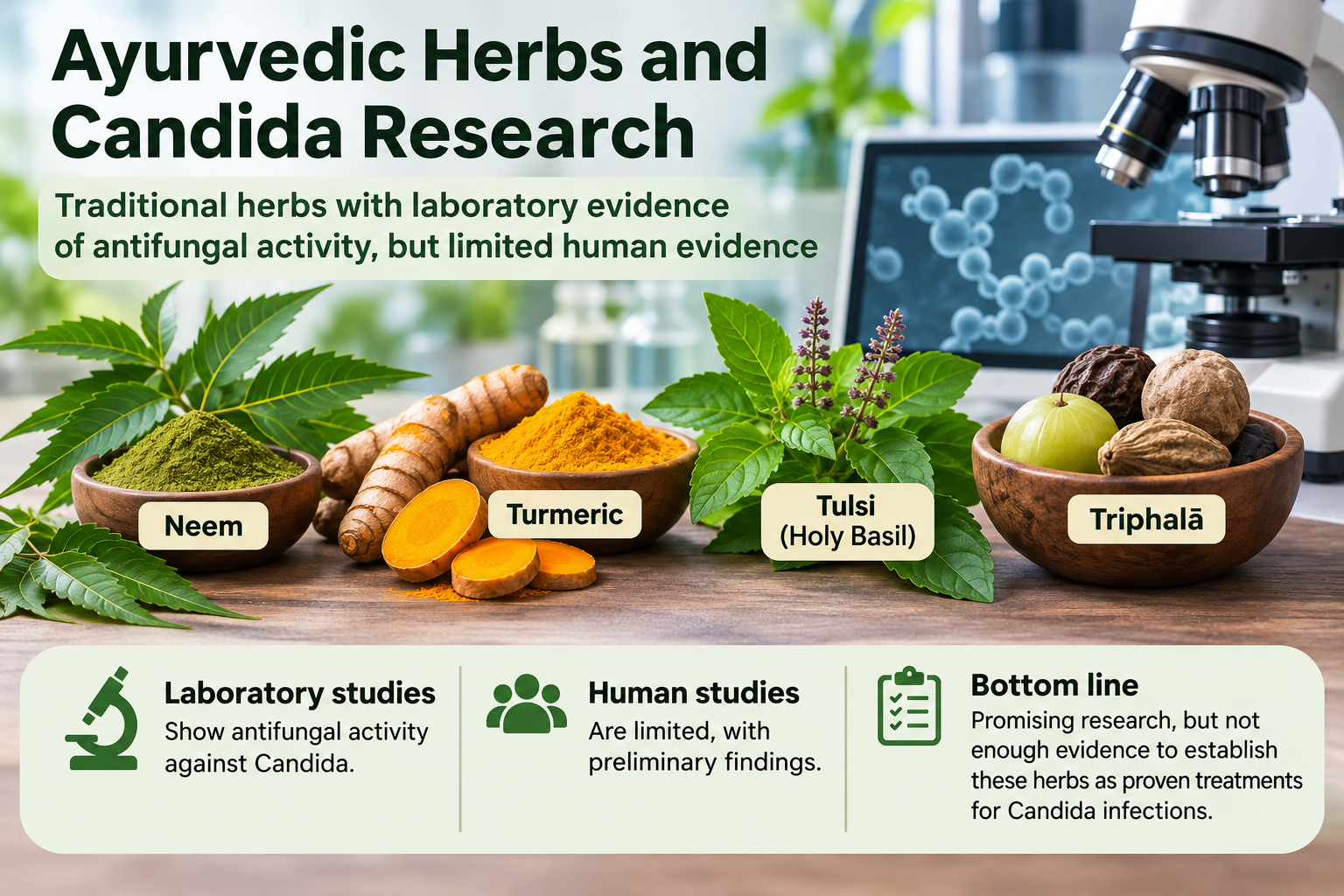
Several plants used in traditional Ayurvedic medicine have been investigated for their potential antifungal properties.
Neem
Neem (Azadirachta indica) is traditionally used in Ayurvedic medicine for a variety of purposes.
Certain neem leaf or oil extracts showed laboratory activity against Candida albicans. These controlled findings do not establish safe or effective treatment in people, and extracts may differ from traditional or commercial products. [6]
Turmeric
Turmeric (Curcuma longa) contains curcumin, a compound that has been studied for its biological properties.
Laboratory research on curcumin and Candida has produced mixed results. Some experiments reported growth inhibition at particular concentrations, while other studies found limited or no activity against tested Candida isolates. Results can vary by Candida strain, concentration and laboratory method. These findings do not establish turmeric or curcumin as a proven treatment for Candida infections in humans. [7, 8]
Preparation, dose, absorption, safety and clinical effectiveness remain uncertain.
Triphalā
Triphalā is a traditional Ayurvedic formulation containing three fruits: Amalaki, Bibhitaki and Haritaki.
It has been investigated for a range of biological properties, including potential antimicrobial effects. More recently, researchers have examined Triphalā Kaṣāya in a clinical study involving women with vaginal candidiasis.
The findings are discussed below, but the research remains preliminary.
Other Ayurvedic herbal preparations
Tulsi (Ocimum sanctum), also known as holy basil, and other plants used in Ayurvedic medicine have been studied for potential antifungal effects. Laboratory studies and a systematic review of microbial research have reported anticandidal activity for certain Tulsi extracts or constituents. These findings are from laboratory research, not clinical trials establishing treatment effectiveness in people. [9]
Much of this research involves laboratory experiments rather than clinical trials in people.
Consequently, it is not currently possible to establish that these herbs provide reliable treatment for Candida infections.
What Does Human Clinical Research Show?
One of the central limitations of research into Ayurvedic treatment for Candida is the shortage of well-designed human clinical trials.
Laboratory studies can help researchers identify substances that affect Candida under controlled conditions. However, a substance that inhibits fungal growth in a laboratory may not achieve the same effect in the human body.
- Clinical research needs to establish whether an intervention:
- Improves symptoms in people with a confirmed infection.
- Produces meaningful microbiological outcomes.
- Is safe at the doses and by the routes used.
- Provides benefits that outweigh its risks.
- Performs adequately in comparison with established treatment.
A 2026 exploratory clinical trial
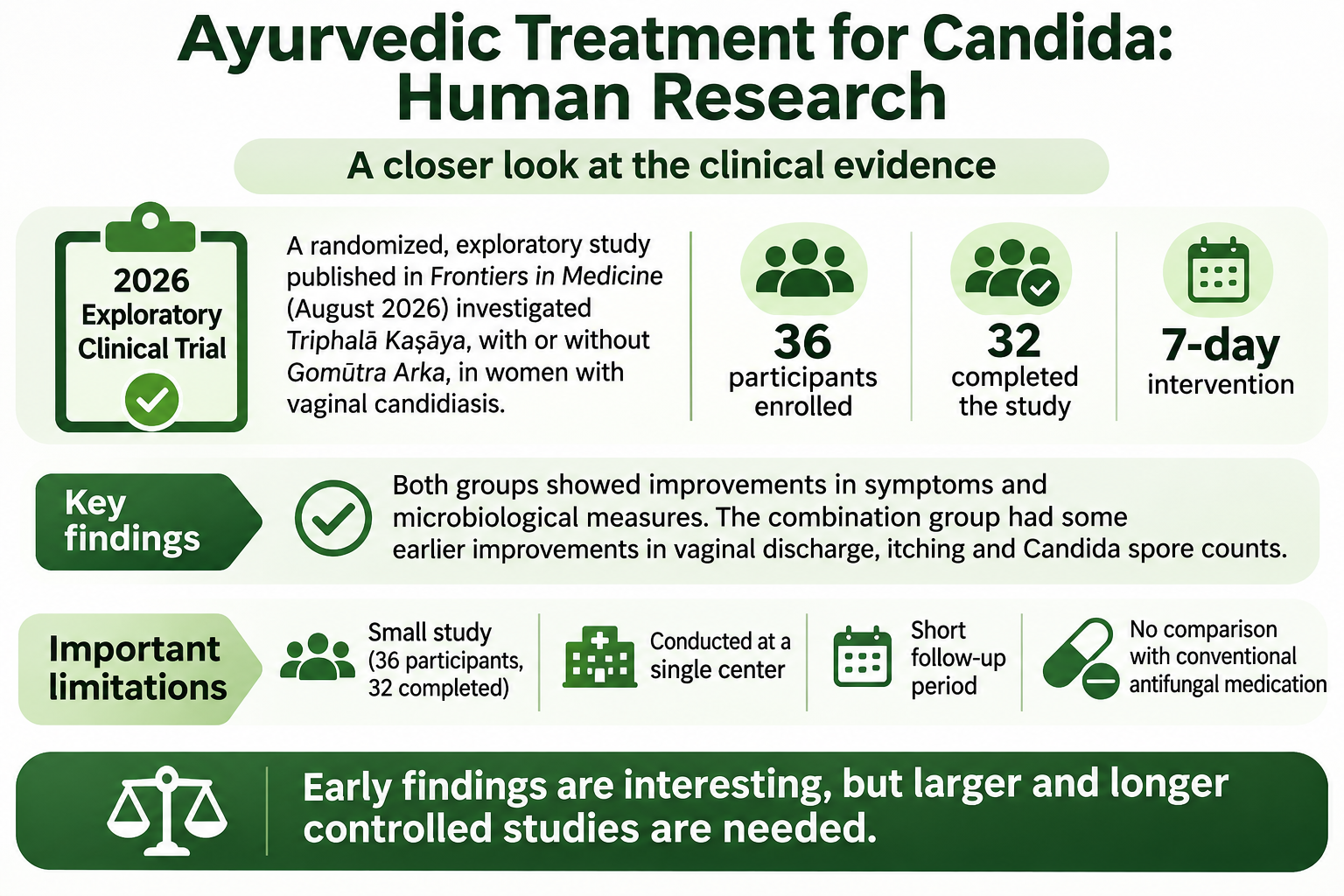
A randomized exploratory clinical trial published in Frontiers in Medicine in August 2026 investigated Triphalā Kaṣāya, with or without Gomūtra Arka, in women with vaginal candidiasis.
The study enrolled 36 participants, with 32 completing the seven-day intervention. One group received Triphalā Kaṣāya vaginal douching, while the other received the same preparation combined with Gomūtra Arka.
Both groups showed improvements in symptoms and microbiological measures. The combination group demonstrated some earlier improvements in vaginal discharge, itching and Candida spore counts.
However, the researchers described the results as exploratory and hypothesis-generating. The study was conducted at a single center, involved a small number of participants and had a short follow-up period.
Importantly, the study did not compare the Ayurvedic preparations with conventional antifungal medication.
The findings therefore do not establish that the intervention is an effective replacement for standard treatment, nor do they demonstrate that Ayurveda as a whole is an effective Candida treatment.
Larger, rigorous trials are needed to confirm these preliminary observations.
Safety Concerns and Limitations
“Natural” does not automatically mean safe.
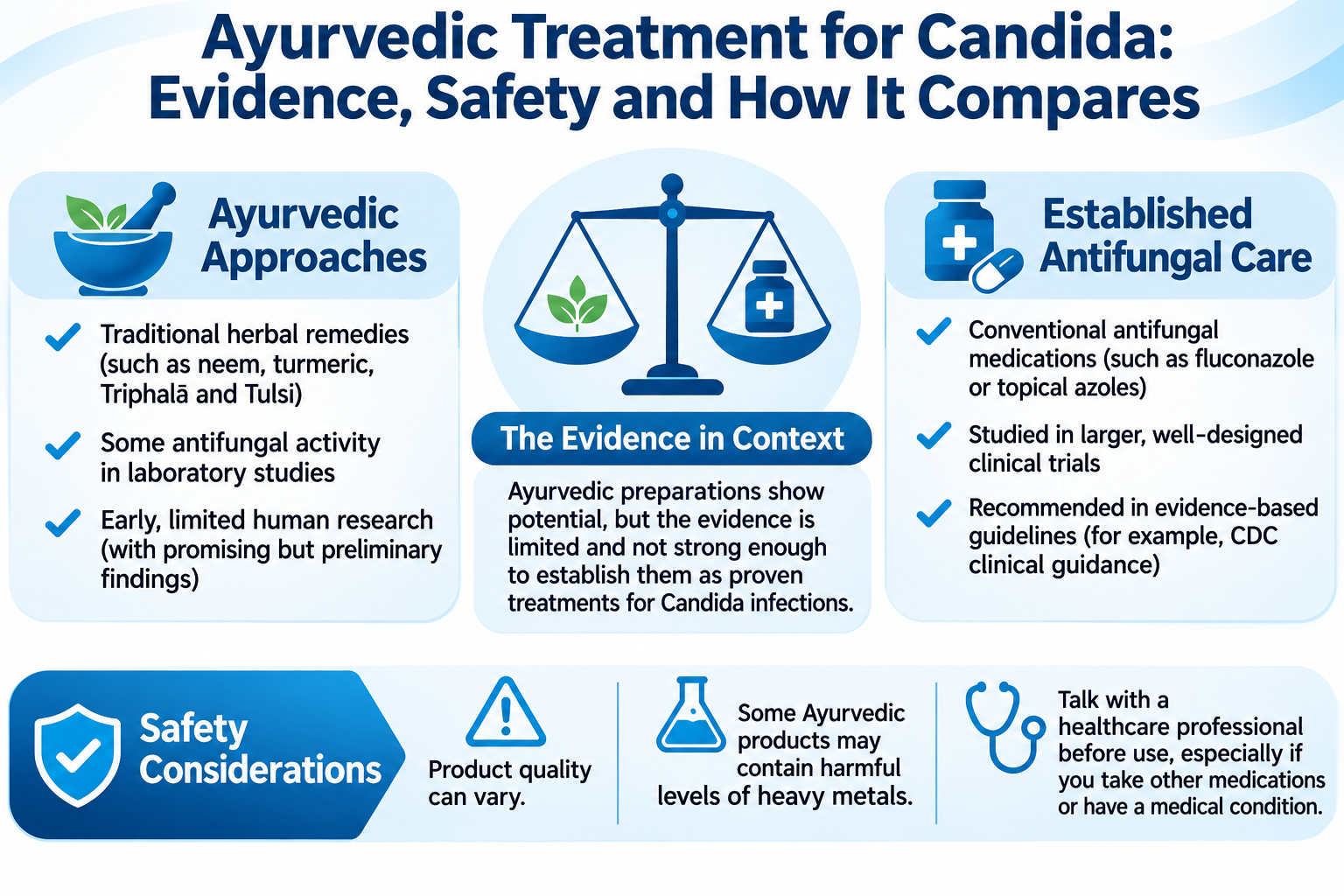
Some Ayurvedic preparations may contain lead, mercury or arsenic. These substances can cause serious health problems, including kidney injury, neurological effects and other forms of toxicity.
Product quality can also vary. Herbal preparations may differ in their ingredients, concentrations, manufacturing standards and potential interactions with medications.
- Other important safety considerations include:
- Possible allergic reactions to herbal ingredients.
- Interactions with prescribed medications.
- Uncertain safety during pregnancy or breastfeeding.
- Risks associated with applying untested preparations to sensitive tissues.
- Delays in receiving an accurate diagnosis or effective treatment.
CDC sexually transmitted infection guidance states that vaginal douching is not recommended because it might increase the risk of vaginal infections, including trichomoniasis. This guidance is not evidence that douching treats candidiasis. Introducing herbal preparations or other substances into the vagina may cause irritation and can complicate the assessment of vaginal symptoms. [10]
Discuss Ayurvedic products with a healthcare professional, especially with medical conditions or prescription medicines.
Ayurvedic Treatment Compared With Established Antifungal Treatment
Established medical treatment for candidiasis uses antifungal medications.
For uncomplicated vaginal candidiasis, commonly recommended treatments include topical azole antifungal medicines, such as clotrimazole or miconazole, and oral fluconazole in appropriate circumstances.
Treatment depends on infection type and severity. Pregnancy, recurrence and certain Candida species require particular consideration.
The evidence supporting conventional antifungal treatment is substantially more developed than the evidence supporting Ayurvedic treatment for Candida.
Ayurvedic practices may be explored as part of a broader discussion about complementary healthcare, but they should not be used to replace prescribed antifungal treatment without medical guidance.
There is currently insufficient evidence to establish that Ayurvedic dietary practices, herbal preparations or lifestyle approaches can reliably eliminate Candida infections.
When Should You Seek Medical Advice?
Symptoms commonly associated with Candida infections can overlap with those of other conditions.
For example, vaginal itching, irritation and discharge can occur with several different vaginal infections. Symptoms alone may not establish the correct diagnosis.
Medical assessment is particularly important when:
- Symptoms persist or recur.
- Treatment has not helped.
- Symptoms are severe or unusual.
- You are pregnant.
- You have diabetes or a weakened immune system.
- You suspect an infection involving the mouth, throat or another part of the body.
A clinician can assess whether Candida is responsible and recommend treatment.
Frequently Asked Questions
Can Ayurveda cure Candida overgrowth?
Clinical evidence is insufficient to establish Ayurveda as a reliable cure for Candida infections; preliminary findings require further research.
Which Ayurvedic herbs are used for Candida?
Neem, turmeric, Triphalā and Tulsi have been investigated, but laboratory findings do not establish effectiveness in people.
Is Ayurvedic treatment safer than conventional antifungal medication?
Not necessarily. Product quality and composition vary, and some products contain toxic heavy metals. Safety depends on preparation, dose, route and individual circumstances.
Can Ayurveda replace antifungals?
Ayurvedic treatment is not an established replacement. Discuss suspected or confirmed candidiasis and treatment choices with a qualified healthcare professional.
Does gut Candida always mean infection?
No. Candida may live in the body without symptoms. Detection alone does not establish illness or a need for treatment.
The bottom line
Ayurveda includes herbs, dietary practices and lifestyle recommendations. Some plants show laboratory antifungal activity, and preliminary human research has investigated specific interventions for vaginal candidiasis.
However, the current evidence does not establish Ayurvedic treatment as a reliable general cure for Candida infections.
Traditional use should be distinguished from proven effectiveness; preparation safety and accurate diagnosis matter.
Established antifungals remain the evidence-based treatment for confirmed candidiasis. High-quality research is needed before Ayurveda can be recommended as an effective alternative.
References
- 1. National Center for Complementary and Integrative Health (NCCIH). Ayurvedic Medicine: In Depth. https://www.nccih.nih.gov/health/ayurvedic-medicine-in-depth
- 2. U.S. Food and Drug Administration (FDA). FDA Warns About Heavy Metal Poisoning Associated With Certain Unapproved Ayurvedic Drug Products. https://www.fda.gov/drugs/fraudulent-products/fda-warns-about-heavy-metal-poisoning-associated-certain-unapproved-ayurvedic-drug-products
- 3. Centers for Disease Control and Prevention (CDC). Treatment of Candidiasis. https://www.cdc.gov/candidiasis/treatment/
- 4. Centers for Disease Control and Prevention (CDC). Vulvovaginal Candidiasis — STI Treatment Guidelines. https://www.cdc.gov/std/treatment-guidelines/candidiasis.htm
- 5. Chandrashekar R, Muraleedharan A, Shivapura Krishnarajabhatt H, Sushilal CMN, Unnikrishnan P. (2026). Exploratory randomized open-label clinical trial of Triphalā Kaṣāya vaginal douche (Yoni prakṣālana) with and without Gomūtra Arka in vaginal candidiasis. Frontiers in Medicine, 13, 1910053. https://doi.org/10.3389/fmed.2026.1910053
- 6. Raghavendra SS, Balsaraf KD. (2014). Antifungal efficacy of Azadirachta indica (neem) — an in vitro study. Brazilian Journal of Oral Sciences, 13(3), 242–245. https://doi.org/10.1590/1677-3225v13n3a15
- 7. Narayanan VS, Muddaiah S, Shashidara R, Sudheendra US, Deepthi NC, Samaranayake L. (2020). Variable antifungal activity of curcumin against planktonic and biofilm phase of different Candida species. Indian Journal of Dental Research, 31(1), 145–148. https://doi.org/10.4103/ijdr.IJDR_521_17
- 8. Zarrinfar H, et al. (2021). Antifungal activity of curcuminoids and difluorinated curcumin against clinical isolates of Candida species. https://pubmed.ncbi.nlm.nih.gov/34981474/
- 9. Anti-candidal Effect of Ocimum sanctum: A Systematic Review on Microbial Studies. (2022). Cureus. https://doi.org/10.7759/cureus.24749
- 10. Centers for Disease Control and Prevention (CDC). Trichomoniasis — STI Treatment Guidelines. https://www.cdc.gov/std/treatment-guidelines/trichomoniasis.htm
Evidence-based health information.
Written by the Understanding Your Microbiome Editorial Team.
Medical information notice: This article is for educational and informational purposes only. It is not a substitute for professional medical advice, diagnosis or treatment. Consult a qualified healthcare professional about symptoms, suspected Candida infections, herbal preparations and treatment decisions.